Venturi Injector Inserts for Runxin Softener Valves
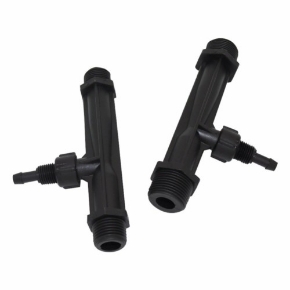
The venturi in a water softener is a vital part of the brine draw system, responsible for pulling saltwater (brine) from the brine tank into the softener’s resin tank during regeneration. It works based on the Venturi effect, where fast-moving water through a narrow nozzle creates suction, this suction then pulls the brine mixture from the brine tank in to water softener's vessel.
A venturi injector insert is a small, crucial component located inside the softener's venturi. The venturi Injector insert controls the rate at which the brine mixture is drawn into the softener's vessel. The larger the Injector insert's port and o-ring are, the faster the brine mixture is drawn. And the smaller, the slower the brine mixture will be drawn into the water softener.
Please note that these Injector Inserts are for the Runxin Brand Range of Softener Valve heads only, and will not fit any other brands of valve heads. Filtershop cannot be held responsible if the insert is ordered for the incorrect brand of softener valve head. These Injector inserts are compatible with the Runxin F63P1, F63P, F116Q1, F63B1, F63B3, F63C1, F63C3, & F64A1 Softener Valve Heads.
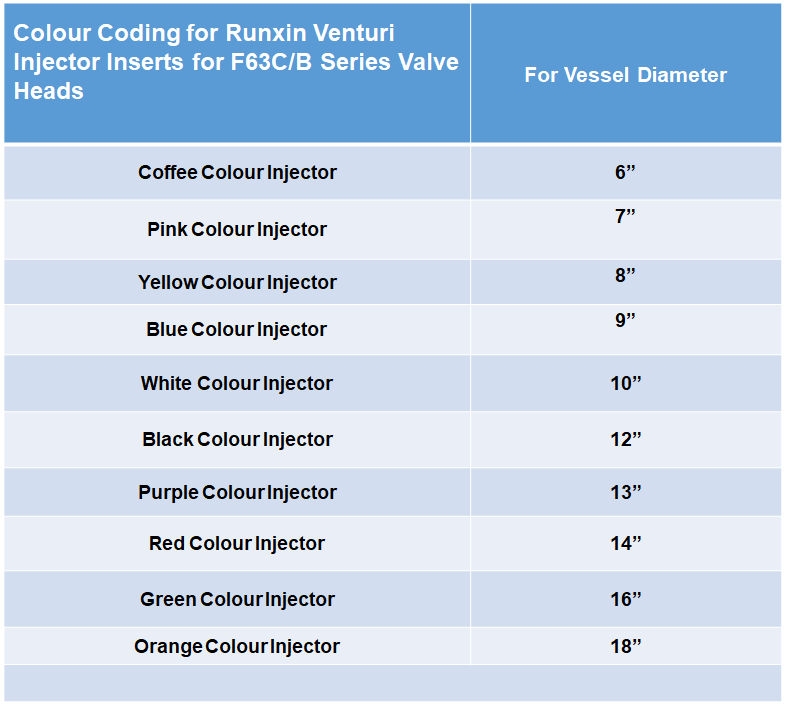
The different sizes of Injector Inserts are colour coded; the correct colour for a water softener will depend on the width of the FRP Vessel used for the water softener. The FRP Vessels are typically rated in inches, Normally, this information can be found on the label on the side of the vessel, which typically states something such as 8x44, which means the vessel is 8" (width) by 44" (Height). So you would then use the 8" (width) as your indicator, which in this case would mean a " Yellow" Injector insert is required for that size softener.
Common issues with an incorrectly sized Softener Venturi Injector Inserts:
- If the brine mixture is drawn too quickly, then the salt may not have adequate contact time with the softening resin for an effective regeneration to occur. Reducing its effectiveness of the regeneration, as well as shortening the amount of time before another regeneration needs to be done.
- Contrary to this, if the brine mixture is drawn too slowly, the softener may complete its regeneration cycle without using an adequate amount of brine mixture to effectively regenerate the softening resin.
- If the brine mixture is drawn too quickly, the brine tank will empty before the softener's regeneration cycle is completed, resulting in unnecessarily wasted water during the regeneration's flush.
- If the brine mixture is not drawn properly, it can also lead to excess salt inside the softener vessel, which in some cases, can lead to " salty"/Brackish taste further down the line.
Maintenance Tips for the Softener Venturi Injector Inserts
- Clogging: Due to sediment, iron, or scale buildup.
- Option 1: Remove brine components, rinse, and clean using a vinegar or a specific iron/scale cleaning solution.
- Option 2: Replacement of Venturi Injector Insert, Brine Piping, Brine Valve Assembly. In some extreme cases, the softener valve itself may need to be sent for repair/refurbishment, or replaced outright with a new valve head.
- Improper Suction/draw from the brine tank.
- If the brine pipework, assembly, and venturi appear free from any kind of blockage. Then check for any damage to the insert, or a missing injector insert, or incorrect installation of the injector insert.
- Check that the injector insert's color, and the water softener's vessel size to ensure that the right size injector insert is being used for the size of vessel.